Essays
MEGO: Who Profits When We Give Up on Understanding
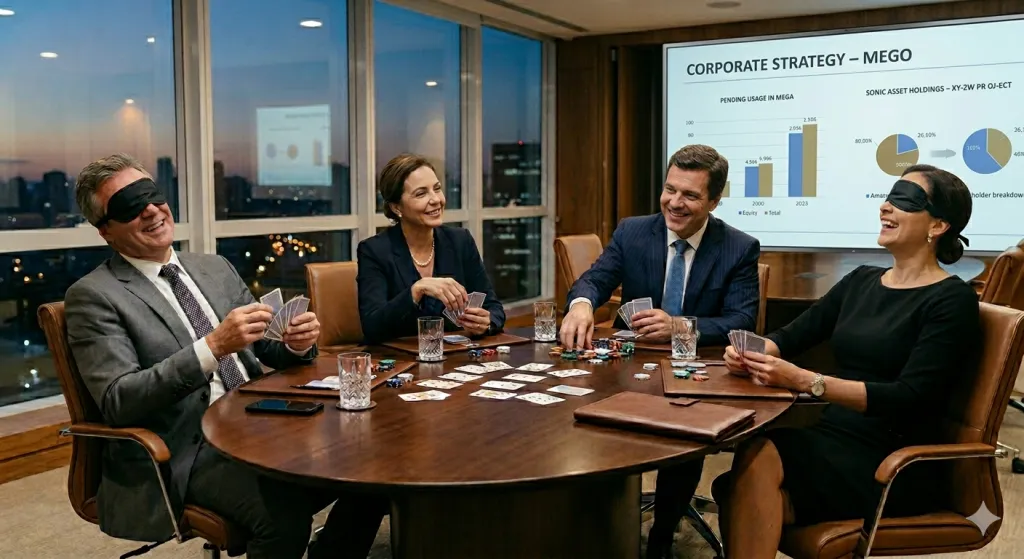
You know the scene. A 47-page contract arrives for approval, with annexes A through F and clauses referencing other clauses. Or a 40-slide deck where the only piece of information that matters - the project is going to be late - sits buried on slide 31, behind three “synergy” charts. We start reading with good intentions. By the third paragraph, our eyes glaze over. We scroll to the bottom, sign, approve, move on with the day.
The phenomenon has a name: MEGO - my eyes glaze over. And naming things is the first step to taming them (name it to tame it). But I want to go beyond the name. I want to look at what this banal gesture - giving up on understanding and pretending we understood - says about who profits from it. And, more uncomfortably: about how much of it happens with our consent.
Every glaze-over is a small surrender. Alone, it means nothing. Accumulated, they become a habit: the habit of handing our understanding over to whoever wrote the document, ran the meeting, built the chart. And understanding handed over is power handed over.
Available is not accessible
The core mechanism of MEGO is this: the information is formally available but inaccessible in practice. Nobody hid anything. The contract is right there, the internal policy is on the wiki, the minutes went out to everyone. If something goes wrong later, the answer will be the classic one: “it was all in the document.”
And it was. That’s the point.
The numbers behind this arrangement have been known for almost two decades. McDonald and Cranor calculated, in The Cost of Reading Privacy Policies (2008), that the average consumer would need about 244 hours a year to actually read the privacy policies of the websites they visit. More than six weeks of full-time work. The entire system operates on the premise that nobody will read.
Here comes the part my skepticism won’t let me ignore: this system isn’t sustained by the bad faith of the writers alone. It’s sustained by a tacit pact. Whoever drafts the unreadable document doesn’t want to be read - they want to be covered. And whoever clicks “I have read and agree” doesn’t want to read either - they want to move on without the weight of having read. Both sides walk away from the transaction relieved. The truth is left an orphan.
Real complexity or manufactured?
Not all fog is fabricated. Some discussions are genuinely complex: distributed systems architecture, fiscal policy, technical regulation. There is no way to simplify them without losing substance. But others are made opaque - out of laziness, bureaucracy, or strategy. How to tell them apart? Here’s a practical test:
Genuine complexity resists simplification. Manufactured opacity resists questions.
Ask an honest expert to explain a hard topic in one sentence and they’ll manage it - losing nuance, warning you about the losses, but they’ll manage. Ask the same question about a deliberately opaque document and what comes back is another layer of jargon, an “it depends,” an invitation to “align offline.” Real complexity has a bottom. Manufactured opacity has only surface, stacked.
There’s still a third possibility, and it’s the most uncomfortable one to admit: sometimes the fog is ours, manufactured by us, for ourselves. We decide not to understand the fine print of the bonus, the target, the layoff announced in corporate speak - because understanding would demand an opinion, and an opinion demands a position, and a position has a cost.
Who profits from our fog
When someone benefits from our giving up on understanding, the conversation stops being about communication and becomes about power. Corporate life offers examples in bulk: vendor contracts with pricing structures that require a spreadsheet of their own to decode (the confusion is not an accident - it’s margin); dashboards with thirty indicators that don’t answer the one question that matters; reorgs announced as “structure optimization to accelerate synergies,” wording calibrated so the word layoff takes a while to form in the reader’s head; the consultant whose jargon guarantees his own indispensability.
Not all of it is deliberate, and that’s the treacherous part. A good share of opacity simply emerges - the document that grew through ten years of revisions, the process that accumulated approvers like rust. Nobody planned the confusion. But emergent opacity still benefits someone: it protects the status quo, because questioning an incomprehensible process costs more energy than living with it. Inertia has an owner, even without a signature.
And before pointing fingers, the mirror. I have produced fog. You probably have too. The report written to impress rather than inform. The technical term used in a meeting not because it was necessary, but because it signaled belonging - and, as a bonus, discouraged questions. Whenever our professional safety rests on what others don’t understand, we are part of the problem this essay describes.
The comfort of not understanding
It would be easy to end the analysis at other people’s malice and innocent fatigue. Our brains have real limits: after a day of six meetings, there is no energy left to dissect a contract. The feeling that “understanding changes nothing” - a kind of corporate learned helplessness - completes the picture. All of that is true, and all of that is only half the story.
The other half is that not understanding is comfortable. Whoever doesn’t understand doesn’t have to disagree. Doesn’t have to raise a hand in the meeting and delay the agenda. Doesn’t have to carry the weight of having seen the problem and stayed silent. Non-understanding works as a moral alibi: we signed, but we didn’t know; we approved, but it was confusing; we went along, because everyone went along.
MEGO, in those moments, stops being fatigue and becomes voluntary anesthesia. And whoever produces 47-page documents knows it. Strategic opacity doesn’t exploit just our tiredness - it exploits our secret wish not to be responsible for what we understand.
When the one who glazes over is the one who decides
There is a version of this comfort that costs more than all the others: the leader who joins the discussion without understanding enough - and decides anyway. When an analyst glazes over, the organization loses a pair of eyes. When the decision-maker glazes over, the entire decision gets made on top of undigested information. With an aggravating factor: at the top, admitting “I didn’t get it” seems to cost too much. Enter the performance - the nod, the jargon repeated back, the posture of someone who “sees the big picture.” The big picture, in practice, is the view of someone who never came down from the lookout.
The mechanics are recognizable. Faced with complexity, aversion - or laziness, which tends to be the same thing wearing a different badge - replaces understanding with shallow heuristics: the analogy with that project from two years ago, the hallway intuition, the “this is simple, just do X.” And when the specialist points out the risk, he becomes the “nitpicker,” the “pessimist,” the one who “overcomplicates.” Notice what happened there: information wasn’t missing. The warning was given, in the room, with data. What happened was an active refusal to process it - because processing it would dismantle the shallow impression on which the decision, secretly, had already been made.
I’ve done time in that room. More than once. I’ve watched specialists patiently explain where the plan would break, and leadership push ahead with the confidence of someone who understood enough - and months later reality collected exactly what had been pointed out. The detail my skepticism won’t let me forget: the bill rarely reaches whoever decided. The team pays - in the replanning, in the late nights, in the eroded credibility. Deciding without understanding is only comfortable because the consequences live at someone else’s address.
It’s tempting to treat this leader as an exotic villain. He isn’t. He is our MEGO with a badge - the same aversion to complexity we forgive in ourselves, multiplied by the reach of the role. And the most corrosive effect isn’t even the bad decision; it’s the cascade. The team learns fast that clarity is unwelcome, because clarity exposes whoever doesn’t understand. So it starts producing reassurance instead of information. The tacit pact closes its cycle at scale: the boss pretends to understand, the team pretends to explain.
Three acts of resistance
The antidote demands no heroism and no extra reading hours. It demands giving up comfort. Three acts, in ascending order of courage:
- Ask the “dumb” question. “I didn’t understand. Can you explain it like I’m new to the team?” Whoever produces opacity counts on our fear of looking ignorant - the simple question disarms that mechanism on the spot. I’ve seen a single question like that unlock more value in a meeting than hours of silent analysis. It’s not a facilitation technique; it’s a refusal to pretend. And it counts double for anyone with a title: a leader who admits “I didn’t understand” gives the whole team license to stop pretending.
- Demand the one-sentence version. Every proposal, contract, or announcement should survive the test: “summarize in one sentence what changes and who is affected.” Whoever can’t either didn’t understand what they wrote, or understood it all too well. In both cases, the refusal to simplify is information.
- Don’t produce fog. The hardest act, because it bills us. Writing the policy anyone can read in two minutes. Delivering the bad news in language that needs no translation. Accepting that being understood leaves us exposed to disagreement - and that this exposure is the price of intellectual integrity.
The fog is not neutral
MEGO disguises itself as an attention problem, as if the failure belonged to the reader. This essay argues otherwise: in the contexts that matter, the glazing of our eyes has usually been priced in by someone - and tolerated by us. Genuine complexity deserves effort. Manufactured opacity deserves questions. And our own fog deserves, at minimum, honesty.
There is a whole layer of this phenomenon left out of here: civic MEGO - citizens who should engage with public policy and budgets, but give up in front of texts that seem written not to be read. What that does to a democracy deserves an essay of its own, and it will come.
For now, the exercise stands. Next time your eyes glaze over in front of something important, don’t scroll to the bottom. Stop and ask the two questions, in this order: “who wins if I don’t understand this?” - and the harder one: “what do I win by pretending I didn’t?”